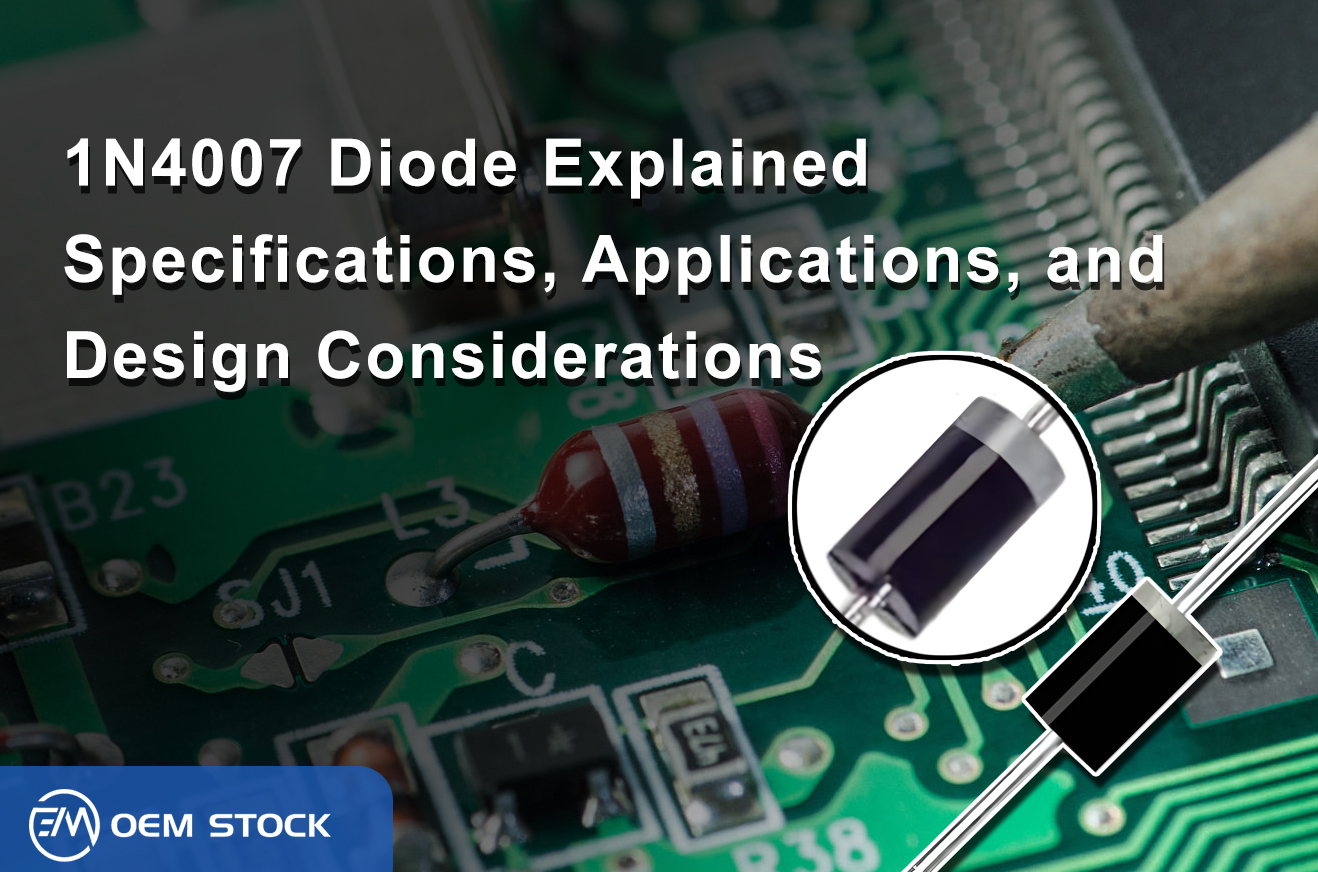
The 1N4007 is one of the most widely used general-purpose rectifier diodes in the electronics industry. Despite its simple structure and low cost, it plays a critical role in power conversion, protection, and basic rectification circuits across consumer, industrial, and automotive electronics.
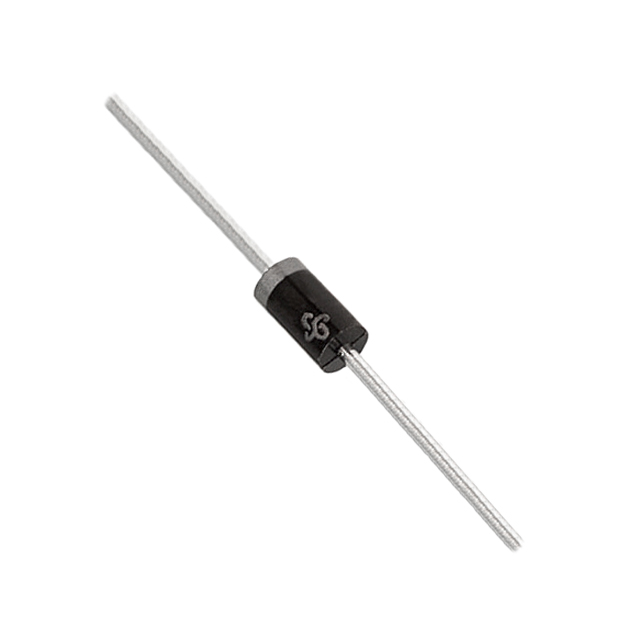
Engineers often select the 1N4007 for its high reverse voltage rating, robust construction, and long-term reliability. However, misunderstanding its limitations-especially switching speed- can lead to improper use in modern high-frequency designs.
Among the entire 1N400x family, the 1N4007 offers the highest reverse voltage rating, making it a universal replacement in many low-frequency rectification applications.

The most common use of the 1N4007 is in AC-to-DC conversion circuits. It is frequently configured in half-wave or full-wave bridge rectifiers for low-frequency power supplies operating at 50Hz or 60Hz.
Due to its high voltage margin, designers often standardize on 1N4007 even when lower-voltage variants (such as 1N4001 or 1N4004) would be electrically sufficient.
In DC input protection circuits, the 1N4007 is commonly placed in series or parallel to prevent damage caused by accidental reverse connection. Its rugged junction structure allows it to tolerate occasional surge currents during fault conditions.
The 1N4007 is widely used as a flyback diode across inductive loads such as relays, solenoids, and small motors. In these applications, switching speed is not critical, and the diode's ability to safely clamp high-voltage transients is more important than fast recovery.
A common mistake among beginners is assuming all diodes behave similarly. The 1N4148 is a high-speed signal diode designed for fast switching and low capacitance, while the 1N4007 is optimized for power handling and voltage endurance.
Substituting a 1N4007 into a high-frequency signal path will often result in signal distortion, increased losses, or malfunction.
Compared to fast recovery rectifiers or Schottky diodes, the 1N4007 exhibits significantly slower reverse recovery behavior. This makes it unsuitable for switch-mode power supplies (SMPS), DC-DC converters, or high-frequency PWM circuits.
One of the reasons the 1N4007 remains popular decades after its introduction is its proven reliability. In properly designed low-frequency circuits, failures are rare, and service life often exceeds the expected lifetime of the product itself.
For engineers working in maintenance, repair, or legacy system support, the 1N4007 continues to be a dependable and readily available solution.
In professional designs, engineers typically select the 1N4007 not for speed, but for its voltage margin, availability, and predictable behavior under low-frequency conditions.
This article is written for electronics engineers and component sourcing professionals, based on commonly accepted industry practices and long-term field usage.
The 1N4007 is not a high-speed or high-efficiency diode by modern standards, but it excels in simplicity, robustness, and cost-effectiveness. When used within its intended operating conditions, it remains one of the most reliable rectifier diodes available.
Understanding where the 1N4007 performs well-and where it does not- is essential for sound engineering design and long-term circuit reliability.
 Upload