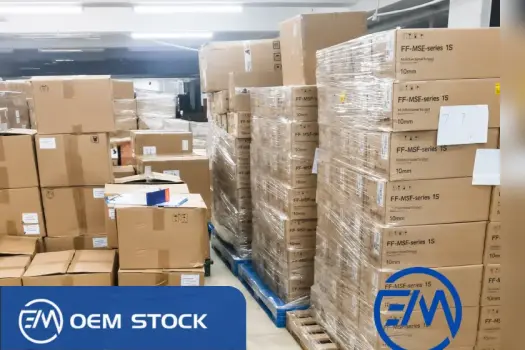
Somewhere in your warehouse, there's probably a pallet of parts nobody has touched in months. Maybe it was a component swap that never got used. Maybe demand shifted and the order already shipped. Either way, it's sitting there, tying up cash and taking up shelf space you could use for something that actually sells.
That's excess and obsolete inventory, usually shortened to E&O. It's one of the quietest costs in electronics manufacturing, and one of the easiest to ignore until your finance team forces the issue. We work with OEMs and EMS providers on this every day at OEM Stock, so we'll walk you through what causes it, how to keep it from piling up, and what to do with the stock you're already sitting on.
Excess stock still has a demand path. You just have more of it than you'll use in a reasonable window. Obsolete stock is different: there's no demand path left at all(think discontinued parts or components a supplier stopped making). We've covered both terms in more depth in our guides on what is excess inventory and what is obsolete inventory, so we won't repeat that here.
Components age faster than most products. A part that's standard today can hit end-of-life in eighteen months. Add in the ordering panic from the recent chip shortage, when teams double- and triple-ordered just to protect production, and you get warehouses full of parts nobody needs anymore. Design changes make it worse. Every time an engineer swaps a component mid-project, the old stock becomes dead weight.
You reduce E&O inventory by tightening forecasting, adjusting how you order, and reviewing stock before it becomes a problem instead of after. Here's where to start:
Here's the real math. A write-off gets you nothing back. Selling that same stock to a buyer, even at a discount, puts actual cash on your books instead of a loss. That's not a small difference when you're talking about a full pallet of ICs or connectors.
At OEM Stock, we buy and resell excess electronic components directly from manufacturers, so you don't have to shop those parts around to a dozen brokers or wait months for a buyer. Send us your list, and we'll give you a straight answer on what it's worth. If you're staring down a quarter-end audit, that answer is worth getting early.
Holding onto E&O inventory isn't a neutral choice. It's an active drain on your business, and it shows up in three places.
Most teams don't find E&O inventory until the annual audit. By then, the parts have been sitting for a year or more, and whatever value they had has mostly evaporated. Spreadsheet tracking doesn't help much either. It's usually updated monthly at best, so a part can go stale for weeks before anyone notices. And because finance, supply chain, and sales rarely share ownership of the problem, nobody feels responsible until the write-off lands on someone's desk.
Once you've got a list of at-risk parts, you have a few real options, and none of them involve simply forgetting about the problem.
Global disposal of electronic waste must comply with regulations such as the Basel Convention.
Not every part needs the same treatment. A quick way to sort your list:
|
Stock Age |
Demand Still Exists? |
Recommended Action |
|
Under 6 months |
Yes |
Hold, monitor usage |
|
6–12 months |
Yes, but slowing |
Sell or return to supplier |
|
12–24 months |
Limited |
Liquidate or repurpose |
|
24+ months |
None |
Recover value fast or dispose |
The older a part gets, the fewer good options you have left(which is exactly why waiting rarely pays off).
Dead stock usually refers to finished goods that have stopped selling. E&O inventory covers components and raw materials specifically, and includes both stock you have too much of (excess) and stock with no remaining use (obsolete).
The 80/20 rule, also called the Pareto principle, says that roughly 80% of your stock problems usually come from about 20% of your SKUs. For E&O specifically, that means a handful of parts are probably driving most of your excess and obsolete stock, so start your review there instead of auditing everything at once.
Monthly reviews catch problems far earlier than the standard annual or quarterly audit cycle most companies default to.
Most companies compare on-hand quantity against forecasted or historical demand over a set window, often 12 to 24 months, then flag anything with little or no remaining demand coverage. From there, reserves are usually set by age: parts sitting 12+ months might get a 50% reserve, while anything past 24 months gets written down further or to zero.
Selling the stock typically lets you reverse part of the reserve you'd already set aside, since you're recovering real value instead of writing it off completely. Your accounting team can confirm the exact treatment for your books.
Selling almost always recovers more value than a straight write-off, since a write-off records the full loss with nothing coming back.
Buyers typically price based on part demand, condition, remaining shelf life, and current market rates for that specific component.
You don't need to wait for the next audit to deal with the stock sitting in your warehouse.Request a quote from OEM Stock, and we'll help you figure out what it's worth before it's worth nothing.
Turning excess into value. Every component counts, every partnership matters.
 Upload