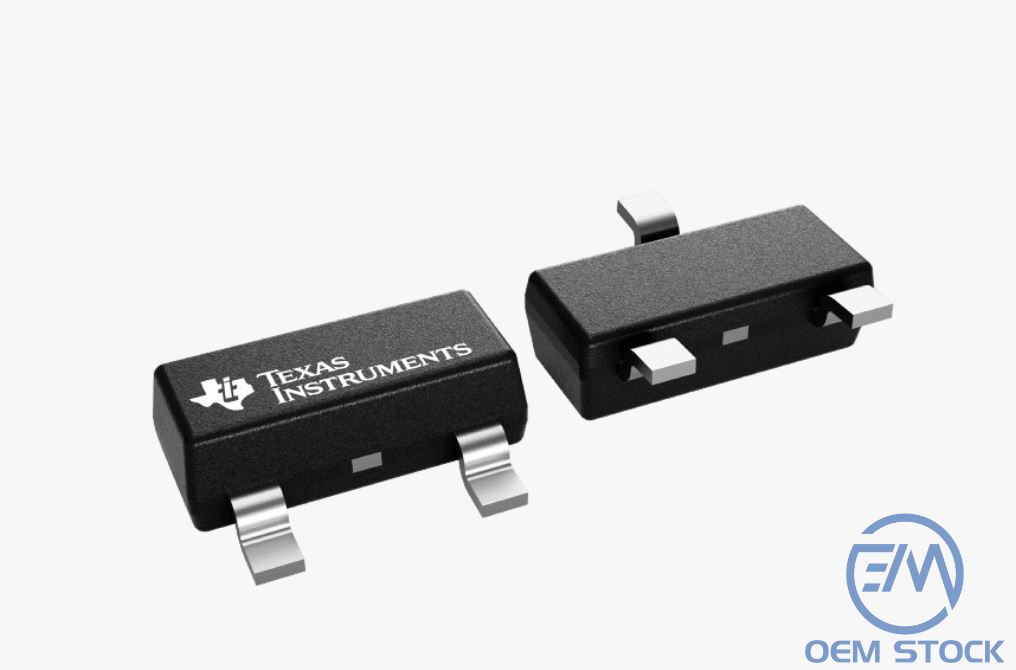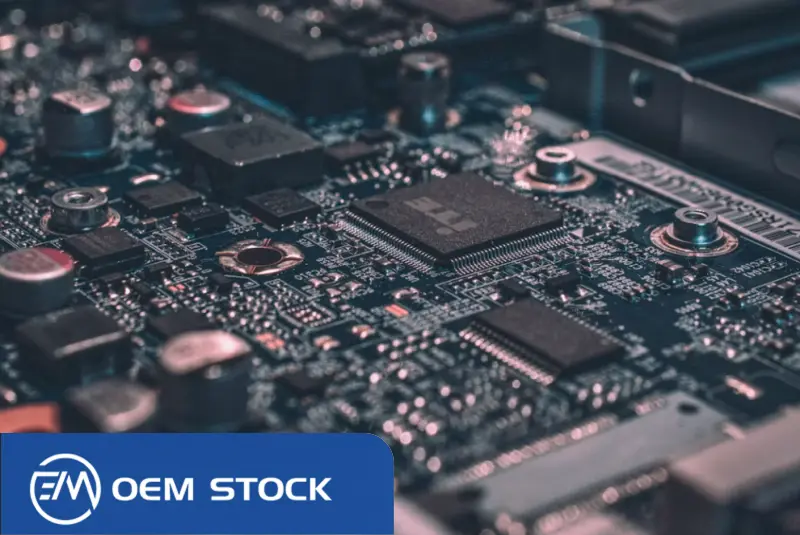
An integrated circuit (IC) is a semiconductor device that combines many tiny electronic components, such as transistors, resistors, capacitors, and diodes, into one compact chip.
"IC" stands for integrated circuit, meaning that multiple circuit elements are integrated into a single semiconductor structure instead of being assembled separately on a printed circuit board.
Depending on its design, an IC can process data, store information, amplify signals, regulate power, control communication, or run embedded software.
Integrated circuits are important because they make electronic products smaller, faster, more reliable, and more energy efficient than circuits built from many separate components.
From smartphones and computers to automotive control units, industrial robots, medical devices, power supplies, and wireless modules, ICs are the foundation of modern electronics applications.
For engineers, ICs enable complex designs in limited board space. For procurement teams, they are critical components that must be sourced carefully, especially when parts are in short supply, end-of-life, obsolete, or available only through surplus inventory channels.
The simplest definition of an integrated circuit is this: an integrated circuit is a miniature electronic circuit manufactured on a single piece of semiconductor material, usually silicon, and packaged so it can be mounted on a printed circuit board.
Integrated circuits are also called ICs, chips, microchips, or IC chips. These terms are often used interchangeably, although "IC" describes the circuit and "chip" usually refers to the physical semiconductor device or packaged component.
Many buyers and new engineers use these terms together, but they do not mean the same thing.
| Term | Meaning | Relationship to ICs |
|---|---|---|
| Semiconductor | A material or device category with controllable electrical behavior | ICs are semiconductor devices |
| Transistor | A semiconductor device used for switching or amplification | Most ICs contain many transistors |
| Integrated circuit | A complete or partial circuit built into one semiconductor chip | The main subject of this guide |
| Chip or microchip | Common name for a packaged IC or semiconductor die | Often used interchangeably with IC |
| PCB | Printed circuit board that connects components | ICs are mounted onto PCBs |
There are many types of integrated circuits. The most common classification is by function and signal type.
Analog integrated circuits process continuous signals. These signals can represent sound, temperature, pressure, voltage, current, RF energy or other real-world conditions.
Applications include:
- Amplifier ICs
- Operational amplifiers
- Comparators
- Voltage references
- Voltage regulators
- Sensor interface ICs
Analog ICs are selected based on parameters such as input offset, noise, gain, bandwidth, supply-voltage range, temperature range, and package.
Digital integrated circuits process binary data. They use logic states to perform calculations, control, timing, and communication.
Applications include:
- Processor ICs
- Microprocessors
- FPGAs
- Counters and timers
- Digital interface ICs
Digital ICs are selected based on voltage level, speed, logic family, memory size, interface support, package and lifecycle.
Mixed-signal ICs combine analog and digital circuits on one chip. They are essential when a system must interact with real-world signals and digital processors.
Applications include:
- ADCs
- DACs
- Clock and timing ICs
- Audio codecs
- Sensor hubs
- Data acquisition ICs
Mixed-signal ICs often require careful PCB layout because analog noise, digital switching and power integrity can affect performance.
Memory ICs store data or program code.
Applications include:
- DRAM for system memory
- SRAM for high-speed memory
- NAND Flash for storage
- NOR Flash for boot code
- EEPROM for configuration data
Memory IC sourcing is sensitive to density, speed grade, package, interface, temperature grade and lifecycle.
Power ICs manage voltage, current, battery charging and power sequencing.
Applications include:
- PMICs
- LDO regulators
- Buck and boost converters
- Gate drivers
- Battery management ICs
Power IC procurement must check exact package, thermal pad, switching frequency, output current and protection features.
RF integrated circuits process high-frequency signals used in wireless systems.
Applications include:
- Wireless communication
- RF front-end ICs
- Low-noise amplifiers
- Mixers
- PLLs
- RF switches
- Transceivers
RF ICs require strict attention to frequency range, gain, noise figure, impedance matching, layout and packaging.
Microcontroller ICs combine a processor core, memory and peripherals in one chip. They are widely used in automotive electronics, industrial control, appliances, power tools, smart meters, lighting systems and IoT devices.
Common selection factors include:
- CPU architecture
- Flash and RAM size
- GPIO count
- ADC resolution
- Communication interfaces
- Temperature grade
- Package and pin compatibility
- Long-term availability
For long-lifecycle products, microcontroller EOL risk should be monitored early because replacing an MCU can require hardware, firmware and qualification changes.
Analog ICs and digital ICs differ mainly in the type of signal they process.
| Category | Analog IC | Digital IC |
|---|---|---|
| Signal | Continuous | Binary |
| Function | Amplification, sensing, filtering, regulation | Processing, logic, counting, memory control |
| Example | Amplifier, voltage regulator, comparator | CPU, MCU, logic IC, memory controller |
| Key concerns | Noise, offset, gain, stability, bandwidth | Speed, voltage level, timing, logic compatibility |
| Common applications | Audio, sensors, RF, power supplies | Computing, embedded control, communication, memory |
Many modern systems use both. For example, an industrial sensor may use an analog front end to read a weak signal, an ADC to convert that signal, and a microcontroller to process the digital data.
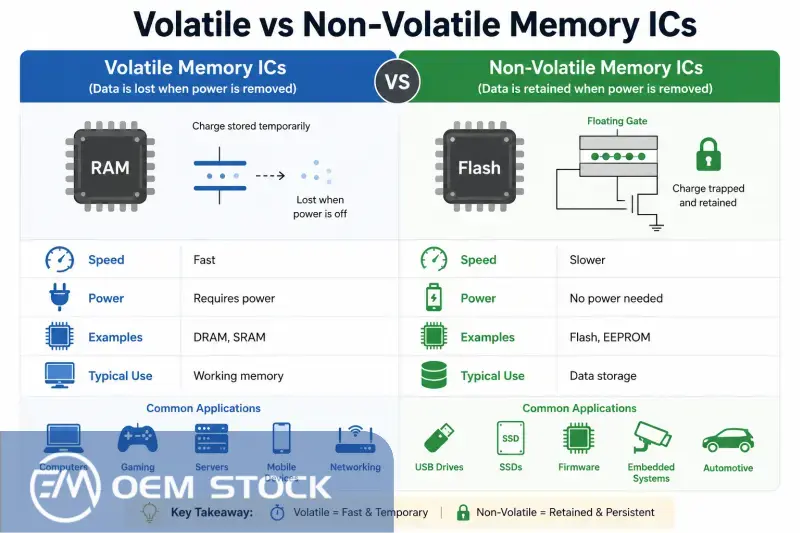
Memory chips store information as electrical states. Some memory loses data when power is removed. Other memories retain data without power.
Volatile memory requires power to hold data. DRAM stores data in tiny capacitors and must be refreshed regularly. It is dense and widely used as main memory in computers, servers and graphics systems.
SRAM stores data using transistor-based cells. It is faster than DRAM but less dense and more expensive, so it is often used for cache or embedded memory.
Non-volatile memory retains data when power is removed. NAND Flash is used for mass storage in SSDs, smartphones, industrial modules, and memory cards. EEPROM is used for smaller amounts of configuration or calibration data. NOR Flash is often used where fast random read access or boot code storage is needed.
| Category | Volatile Memory | Non-Volatile Memory |
|---|---|---|
| Data retention without power | No | Yes |
| Examples | DRAM, SRAM | NAND Flash, NOR Flash, EEPROM |
| Common use | Working memory, cache | Storage, boot code, configuration |
| Buyer concern | Speed, density, package, availability | Endurance, retention, interface, lifecycle |
Integrated circuits perform essential electronic functions within a device or system. Depending on their design, ICs can process data, store information, amplify or convert signals, manage power, and control wired or wireless communication.
Some integrated circuits perform a single dedicated function, such as regulating voltage or converting an analog signal into digital data. Others integrate multiple functions into one chip. For example, a microcontroller may combine a processor core, memory, timers, analog inputs, and communication interfaces.
| Function | Typical IC Types | Common Applications |
|---|---|---|
| Data processing | CPU, MCU, GPU | Computers, servers, embedded systems, industrial controls, automotive modules, and AI systems |
| Data storage | DRAM, SRAM, NAND Flash, NOR Flash, EEPROM | Computers, SSDs, smartphones, industrial equipment, and embedded devices |
| Signal processing | ADC, DAC, amplifier IC, audio codec | Sensors, medical electronics, industrial measurement, audio equipment, and RF systems |
| Power management | PMIC, voltage regulator, DC-DC converter, battery charger IC | Power supplies, portable electronics, vehicles, and battery-powered systems |
| Communication control | RF IC, Wi-Fi IC, Bluetooth IC, Ethernet PHY, CAN, LIN, RS-485, and USB interface IC | Wireless devices, vehicles, industrial networks, communication equipment, and consumer electronics |
Because many products depend on specific processors, memory chips, power ICs, and communication ICs, component availability can directly affect production. When a critical IC becomes supply-constrained, EOL, or obsolete, replacing it may require PCB changes, firmware updates, testing, or product requalification.
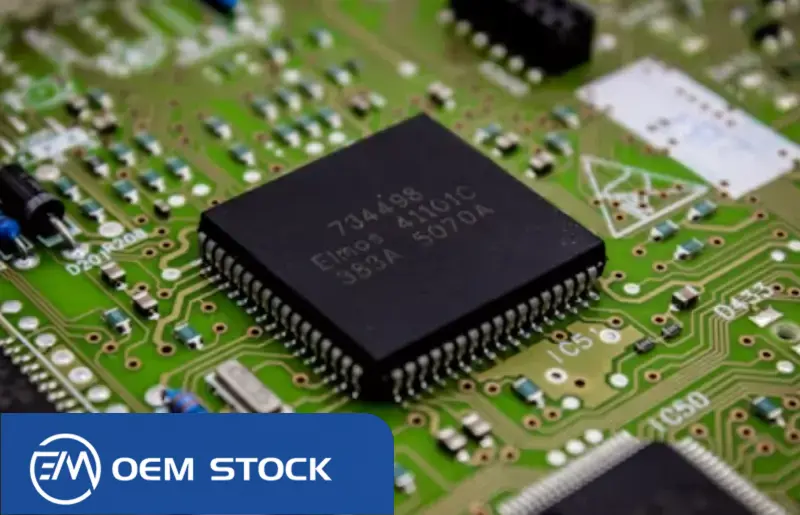
An integrated circuit works by moving electrical signals through microscopic semiconductor structures. Its exact working principle depends on whether the IC is analog, digital, mixed-signal, memory, RF, or power-related, but the basic flow is usually: Input -> Processing -> Output
Most integrated circuits are made on a silicon substrate. Silicon is a semiconductor, which means its electrical behavior can be controlled. It does not conduct electricity as freely as a metal, but it is not a full insulator either. By adding carefully selected impurities through a process called doping, manufacturers can create regions that behave in controlled electrical ways.
This controllability makes silicon ideal for transistors, diodes and other microelectronic structures. Other semiconductor materials, such as gallium arsenide or gallium nitride, may be used in specialized RF, optical or power applications.
The transistor is the most important building block inside most ICs.
In digital circuits, transistors act as switches. They turn on or off to represent binary logic states, usually 0 and 1. When billions of transistors are connected into logic gates, registers, memory arrays and processing units, they can run software and perform complex computation.
In analog circuits, transistors can amplify signals or control current. In power ICs, they can regulate or switch larger currents. In RF ICs, they help process high-frequency signals used in wireless communication.
An IC receives one or more inputs, processes those signals internally and produces outputs.
For example:
- A temperature sensor IC receives a physical temperature change, converts it into an electrical signal, and outputs data.
- A microcontroller receives input from sensors, executes firmware instructions and controls motors, relays, displays or communication interfaces.
- A voltage regulator receives an unstable input voltage and outputs a stable voltage rail.
- An ADC receives an analog voltage and outputs digital data.
The signal path inside an IC is defined by the internal transistor network, interconnect layers, and circuit architecture.
Integrated circuits are built in wafer fabs. A silicon wafer goes through repeated process steps that create layers, patterns, and connections. The wafer is then diced into individual dies, packaged and tested.
Important terms include:
- Wafer: A thin circular slice of semiconductor material.
- Die: One individual IC circuit cut from the wafer.
- Layers: Repeated material levels that form transistors, insulation and metal routing.
- Interconnection: Metal paths that connect internal devices.
- Package: The protective body and external connection system around the die.
For buyers, the finished packaged IC is what appears on a bill of materials. For engineers, the internal die and package both matter because they affect performance, heat, reliability, and availability.
IC packaging protects the die and connects it to the PCB. Package choice affects performance, compatibility, assembly process, inspection, repairability and sourcing.
DIP, or dual in-line package, is a common through-hole package. It has pins on two sides and is inserted through holes in a PCB. DIP packages are common in older designs, prototypes, education and repair, but are less common in compact modern products.
Surface mount packages are mounted directly onto PCB pads.
Widely used surface mount packages include:
- SOP or SOIC: Small-outline packages with leads on two sides.
- QFP: Quad flat package with leads on four sides.
- QFN: Quad flat no-lead package with pads under or around the package.
- TSSOP and MSOP: Thin and small-outline packages used where space is limited.
Surface-mount packages support high-volume automated assembly and smaller PCB layouts.
Advanced IC packages support high pin counts, high bandwidth, compact design and better system integration.
Examples include:
- BGA: Ball grid array package with solder balls underneath.
- 2.5D IC: Multiple dies placed on an interposer or advanced substrate.
- 3D IC: Dies are stacked vertically and connected through advanced interconnect.
- SiP: System-in-package combining multiple components in one package.
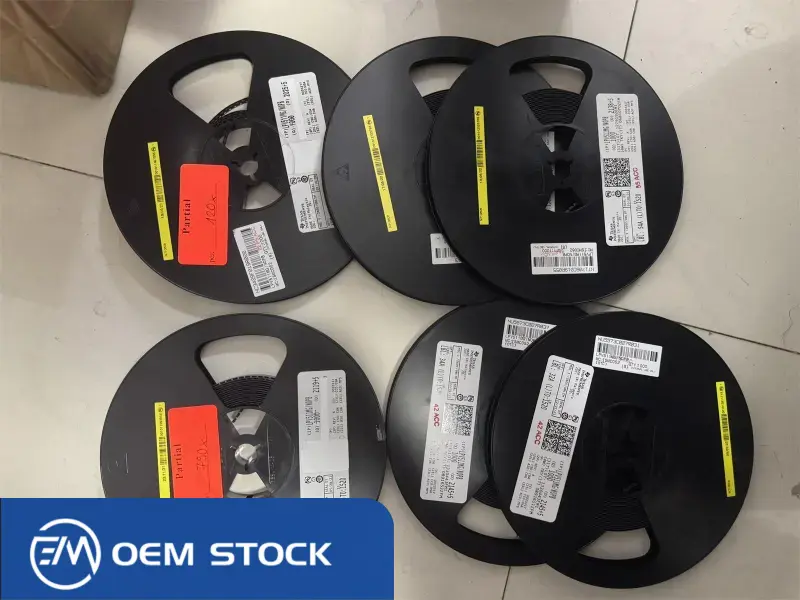
Package type affects sourcing. A correct base part number with the wrong suffix, package, reel format or temperature grade may not be usable. In real BOM reviews, this is one of the easiest mistakes to miss because the difference may appear only in the final characters of the part number. Procurement teams should always verify the full manufacturer part number before approving a purchase.
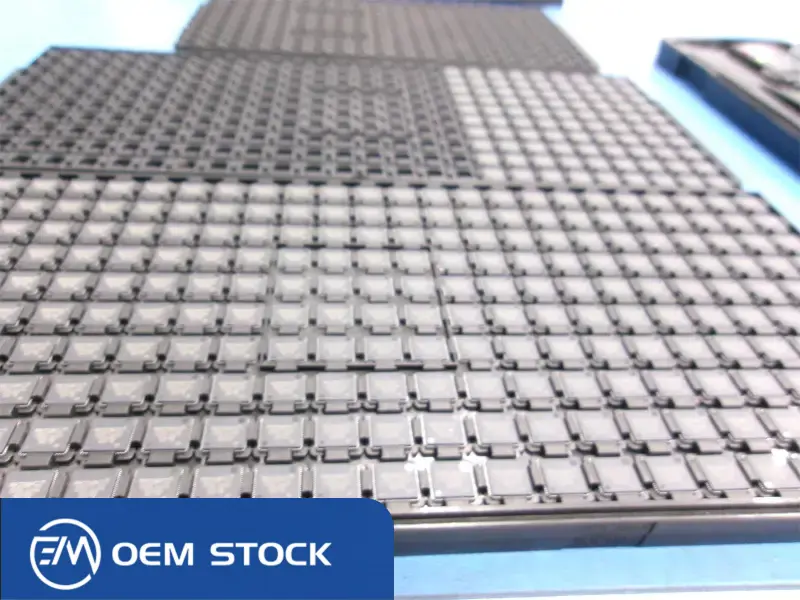
Integrated circuits are important because they make modern electronic systems practical. Without ICs, products would be larger, slower, more expensive, and less reliable.
ICs put many functions into one small package. This allows designers to reduce PCB size and build compact devices such as smartphones, wearables, sensors, medical instruments, and embedded modules.
Because internal components are extremely close together, signals travel shorter distances. Shorter signal paths support faster switching, lower delay and higher operating frequency.
Integrated circuits usually consume less power than equivalent circuits built from discrete components. This is essential for battery-powered products, automotive modules, IoT devices and energy-efficient data centers.
Fewer external solder joints and shorter interconnections reduce failure points. IC manufacturing also provides repeatability at scale, which supports consistent electrical performance.
Although advanced IC design and fabrication are expensive, mass production reduces cost per function. One IC can replace many individual components, saving board space, assembly time and logistics complexity.
Integrated circuits are used across almost every electronics industry, from consumer devices and vehicles to industrial systems, communication equipment and AI hardware.
Smartphones, computers, TVs, wearables, chargers, cameras and home appliances all use ICs. A smartphone may include processor ICs, memory ICs, RF ICs, PMICs, display drivers, audio codecs, sensor ICs, and charging ICs.
Modern vehicles use ICs in engine control units, body control modules, infotainment, lighting, battery management, ADAS, EV inverters, charging systems and safety electronics. Automotive ICs often require extended temperature ratings and long-term supply planning.
Industrial systems use ICs in PLCs, robotics, motor drives, power supplies, sensors, HMI panels and factory communication systems. Industrial products often have longer lifecycles than consumer products, which increases the risk of obsolete IC sourcing.
Wi-Fi, Bluetooth , 5G, Ethernet, optical modules, routers and base stations all depend on integrated circuits. Communication ICs may combine RF, mixed-signal and digital processing functions.
AI applications use GPUs, AI accelerators, high-bandwidth memory, power ICs and advanced packaging technologies. These systems place heavy demands on performance, memory bandwidth, thermal management and power efficiency.
The internal structure of an IC depends on its function, but common elements include:
Modern ICs may contain thousands, millions or billions of transistors. A simple voltage regulator may contain a modest number of devices. A microprocessor, GPU or AI accelerator may contain extremely dense logic, memory, interconnect, cache and control blocks.
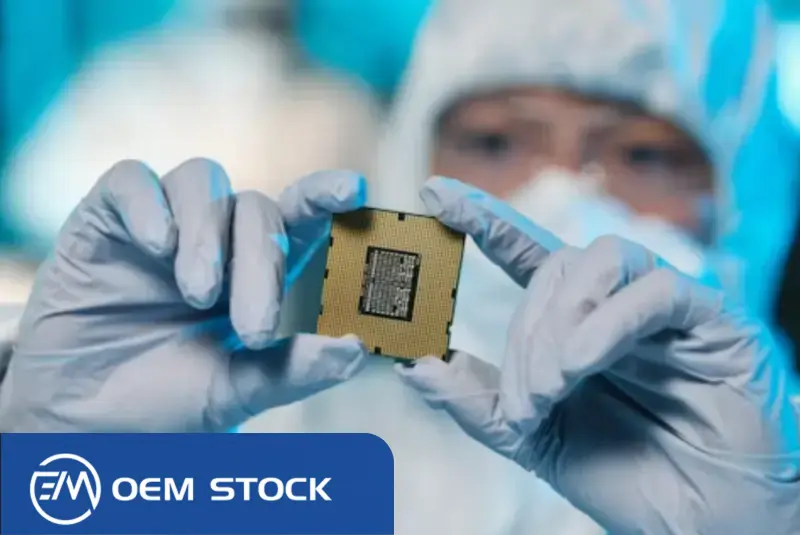
The IC manufacturing process is highly complex, but it can be summarized in seven main stages. The following is a simplified overview.
Manufacturing begins with high-purity semiconductor wafers, usually made from single-crystal silicon. The wafers are sliced, polished and thoroughly cleaned to provide a smooth, contamination-free surface for device fabrication.
Thin layers of insulating, conducting, or semiconductor materials are deposited or grown on the wafer. These layers form the foundation for transistors, electrical isolation, and internal connections.
Photolithography transfers circuit patterns onto the wafer. During photolithography, a circuit pattern from a mask or reticle is transferred onto a photosensitive material called photoresist. This process defines microscopic features across each layer of the IC. This process defines microscopic features across each layer of the IC.
Etching removes selected material to create the required circuit structures. Doping introduces controlled impurities into specific regions of the silicon to modify its electrical behavior and form semiconductor devices such as transistors and diodes.
Photolithography, etching, deposition, and doping are repeated many times to build the complete circuit layer by layer.
Metal layers are added to connect the transistors and other internal components. These microscopic interconnections carry electrical signals and power throughout the integrated circuit.
Before packaging, each die is electrically tested while it is still part of the wafer. This process, often called wafer probing or wafer sort, helps identify dies that meet the required specifications.
The wafer is then cut into individual semiconductor dies.
Qualified dies are assembled into protective packages that provide external electrical connections to a printed circuit board. Common connection methods include leads, pads, and solder balls.
After packaging, the ICs undergo final electrical and functional testing. Depending on the application, manufacturers may also perform temperature testing, burn-in testing, reliability screening, or other qualification procedures. Approved components are then marked, packed, and shipped according to the manufacturer's specifications.
Integrated circuit technology continues to evolve around higher performance, lower power consumption, advanced packaging, and stronger supply chain resilience. Major trends include AI semiconductor development, chiplet architecture, 2.5D and 3D packaging, smaller process nodes, and energy-efficient IC design.
AI workloads require massive parallel processing, high memory bandwidth and efficient power delivery. This is driving demand for GPUs, AI accelerators, high-bandwidth memory, advanced PMICs and high-speed interconnect technologies. As AI systems become more powerful, IC design must balance performance, thermal management, power efficiency and package-level integration.
Chiplet architecture breaks a large system into smaller dies that can be connected inside one package. This approach can improve yield, support modular design and allow different functions to use different manufacturing nodes. For example, logic, memory, I/O and acceleration blocks may be manufactured separately and then integrated into one advanced package.
Advanced packaging is becoming as strategic as wafer process technology. Technologies such as BGA packages, SiP designs, interposer-based 2.5D integration, vertically stacked 3D integration, and high-density die-to-die interconnects are increasingly important for high-performance integrated circuits.
Surface Mount Packages
Advanced Packaging and Integration Architectures
Advanced process nodes continue to support higher transistor density and lower power per function. However, node names are commercial technology generations rather than simple physical measurements. Engineers should evaluate actual performance, power, area, cost and availability instead of relying only on node labels.
Power efficiency is now a core design goal. Edge AI devices, EVs, data centers, industrial sensors, and battery-powered products all require ICs that deliver more performance per watt. For OEM buyers, energy-efficient ICs can also affect thermal design, product reliability, battery life and long-term sourcing decisions.
Choosing an integrated circuit is not only an engineering decision. It is also a supply chain decision. A part may meet the electrical requirements but still be risky if it has poor availability, a short lifecycle, limited package options or no practical substitute.
For a new design, engineering and procurement teams should evaluate the IC from both sides:
| Selection Factor | Engineering Question | Procurement Question |
|---|---|---|
| Electrical function | Does the IC meet voltage, speed, accuracy, interface, and thermal requirements? | Is the exact part available in the required quantity and lead time? |
| Package | Does the footprint, pinout, and thermal pad match the PCB design? | Is the package suffix correct and available in the required tape-and-reel, tray, or tube format? |
| Temperature grade | Does it meet the operating environment? | Is the required grade available from a stable supply channel? |
| Lifecycle status | Is the part recommended for new designs? | Is it active, NRND, EOL, or already obsolete? |
| Compliance | Does the part meet product and regional requirements? | Are RoHS, REACH, or other compliance documents available if needed? |
| Alternate options | Can the design accept a second source or substitute? | Has engineering approved any alternate manufacturer or part number? |
The best time to reduce sourcing risk is during design, not after a production shortage. For long-lifecycle products, teams should avoid single-source ICs where possible, monitor manufacturer product change notices and plan last-time-buy decisions before a component becomes unavailable.
OEM STOCK helps companies source active, shortage, EOL, and obsolete integrated circuits while also supporting the resale of excess IC inventory. With 26+ years of industry experience, a global supplier network, and access to millions of electronic component SKUs, OEM STOCK can assist with urgent and hard-to-find requirements.
Buyers should provide the manufacturer part number, brand, quantity, package, date code requirements, delivery date, and whether alternatives are acceptable. Sellers can submit excess inventory lists for review and potential resale.
Submit a request for quote for your IC sourcing needs, or upload your stock list to sell excess inventory with OEM STOCK. Our team can review part numbers, check component availability, provide sourcing support, and help with inventory liquidation.
Integrated circuits process data, store information, manage power, convert signals, and control communication in modern electronic systems. Understanding their types, packages, applications, and basic manufacturing processes helps engineers and buyers make better decisions.
When sourcing ICs, teams should verify the full part number, package, lifecycle status, date code, compliance requirements, and delivery schedule. Careful sourcing of active, surplus, EOL, and obsolete ICs can help support production, repair, and long-term maintenance programs.
An integrating circuit is an electronic circuit that produces an output proportional to the accumulated value of an input signal over time. It is commonly built with an operational amplifier, resistor, and capacitor. An integrating circuit is not the same as an integrated circuit, although an integrated circuit such as an op-amp may be used to build one.
By signal type, integrated circuits are commonly divided into analog, digital, and mixed-signal ICs. Analog ICs process continuous signals, digital ICs work with binary data, and mixed-signal ICs combine analog and digital functions on one chip.
An IC is mounted on a printed circuit board and connected to power, ground, input, output, and supporting components according to its datasheet. Depending on its function, it may process data, amplify signals, regulate voltage, store information, control equipment, or provide communication between different parts of a system.
A damaged packaged IC is usually replaced rather than repaired because its internal semiconductor structures are microscopic and sealed inside the package. However, technicians should first check the PCB, solder joints, power supply, surrounding components, and firmware because these problems can sometimes produce symptoms that appear to be caused by a faulty IC.
An IC can be tested by inspecting it for physical damage, confirming its supply voltage and ground connections, measuring input and output signals, and comparing the results with the manufacturer's datasheet. Technicians may use a multimeter, oscilloscope, logic analyzer, component tester, or functional test fixture. In-circuit readings can be affected by surrounding components, so removing or replacing the IC may sometimes be necessary for confirmation.
Common signs of a faulty IC include unusual overheating, excessive current consumption, missing or unstable output signals, intermittent operation, unexpected resets, communication failures, or a circuit that no longer powers on. These symptoms do not always prove that the IC itself is damaged, so the power supply, PCB connections, passive components, and external loads should also be checked.
 Upload