AMS1117-3.3 is one of the most widely used 3.3V LDO (low-dropout) linear regulators in embedded boards, IoT modules, and general-purpose power rails. This guide covers its pinout, key specs, typical application circuit, thermal calculation, and replacement options-so you can choose and use it safely in real designs.
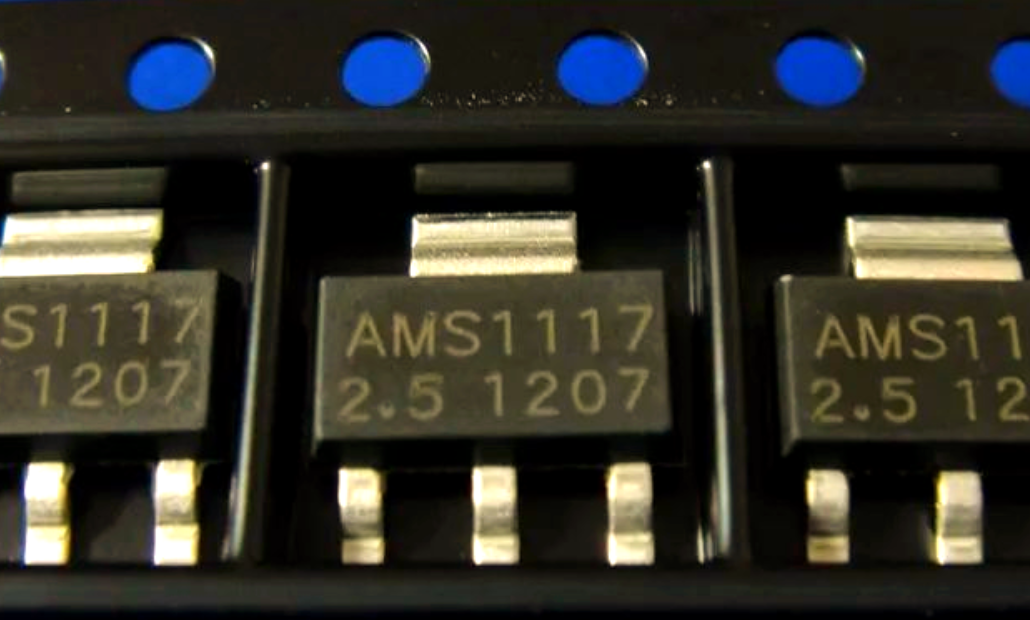
The AMS1117 is a popular LDO linear voltage regulator family originally associated with Advanced Monolithic Systems (AMS), and now widely produced as compatible parts by multiple manufacturers. It comes in fixed-output versions (e.g., 1.2V/1.5V/1.8V/2.5V/3.3V/5V) and an adjustable version.
Among them, AMS1117-3.3 is the most common due to its use in powering 3.3V MCUs and peripherals from a 5V rail.
| Parameter | Typical Value | Notes |
|---|---|---|
| Input Voltage | Up to ~15V | Check exact datasheet per manufacturer |
| Output Voltage | 3.3V (fixed) | Other fixed and adjustable versions exist |
| Max Output Current | Up to 1A | Depends on thermal design & PCB copper |
| Dropout Voltage | ~1.1V @ 1A | Lower current = lower dropout |
| Package | SOT-223 | Tab is usually VOUT |
| Operating Temp | -40°C to +125°C | Varies by vendor grade |
Engineering note: AMS1117 is a linear regulator, not a switching converter. Efficiency is roughly Vout/Vin, and the rest becomes heat.
For the standard SOT-223 package, the pin function is commonly:
| Pin | Name | Function |
|---|---|---|
| 1 | GND / ADJ | Ground for fixed versions; Adjust pin for adjustable version |
| 2 | VOUT | Regulated output |
| 3 | VIN | Input supply |
| Tab | VOUT | Thermal pad connected to output |
Important: Some clones/variants may differ. Always confirm with the specific manufacturer datasheet before final PCB layout.
A stable AMS1117 design typically uses capacitors on both input and output rails. A common practical baseline is:
This is the most common scenario in USB-powered boards, modules, and MCU systems.
Heat is the #1 reason AMS1117 fails in real projects. Calculate dissipation with:
Power Dissipation (W) = (Vin - Vout) × Iout5V → 3.3V at 0.8A:
(5.0 - 3.3) × 0.8 = 1.36 WAt ~1.36W in SOT-223, the device can get very hot without enough copper area (thermal spreading) on the PCB.
In many practical circuits, AMS1117 and LM1117 are drop-in compatible in the same package and pinout. However, real-world behavior can vary depending on:
| Item | AMS1117 | LM1117 (family) |
|---|---|---|
| Availability | Very high | High |
| Dropout | ~1.1V @ 1A (typical) | ~1.2V @ 1A (typical) |
| Common use | Low-cost modules/boards | Broader vendor options |
If AMS1117-3.3 is out of stock, you can typically consider:
Replacement checklist: verify pinout, current rating, dropout, stability capacitor requirements, and package footprint.
No. AMS1117 is a linear LDO. It does not switch, and it dissipates excess voltage as heat.
Some versions allow high input voltage, but thermal dissipation becomes the real limit. For 12V→3.3V at meaningful current, use a buck converter.
Because (Vin - Vout) × Iout becomes large. High current + large voltage drop = heat. Add copper area or change topology.
In most common 3.3V designs with SOT-223 footprints, yes-but always confirm stability requirements and vendor datasheet.
AMS1117-3.3 is a low-cost, widely available LDO that works well for simple 5V→3.3V rails-especially in MCU modules and compact boards. The key to success is thermal design and correct capacitor selection. If your efficiency or temperature margin is tight, consider moving to a switching buck converter.
 Upload