MCU Fundamentals · Article 3
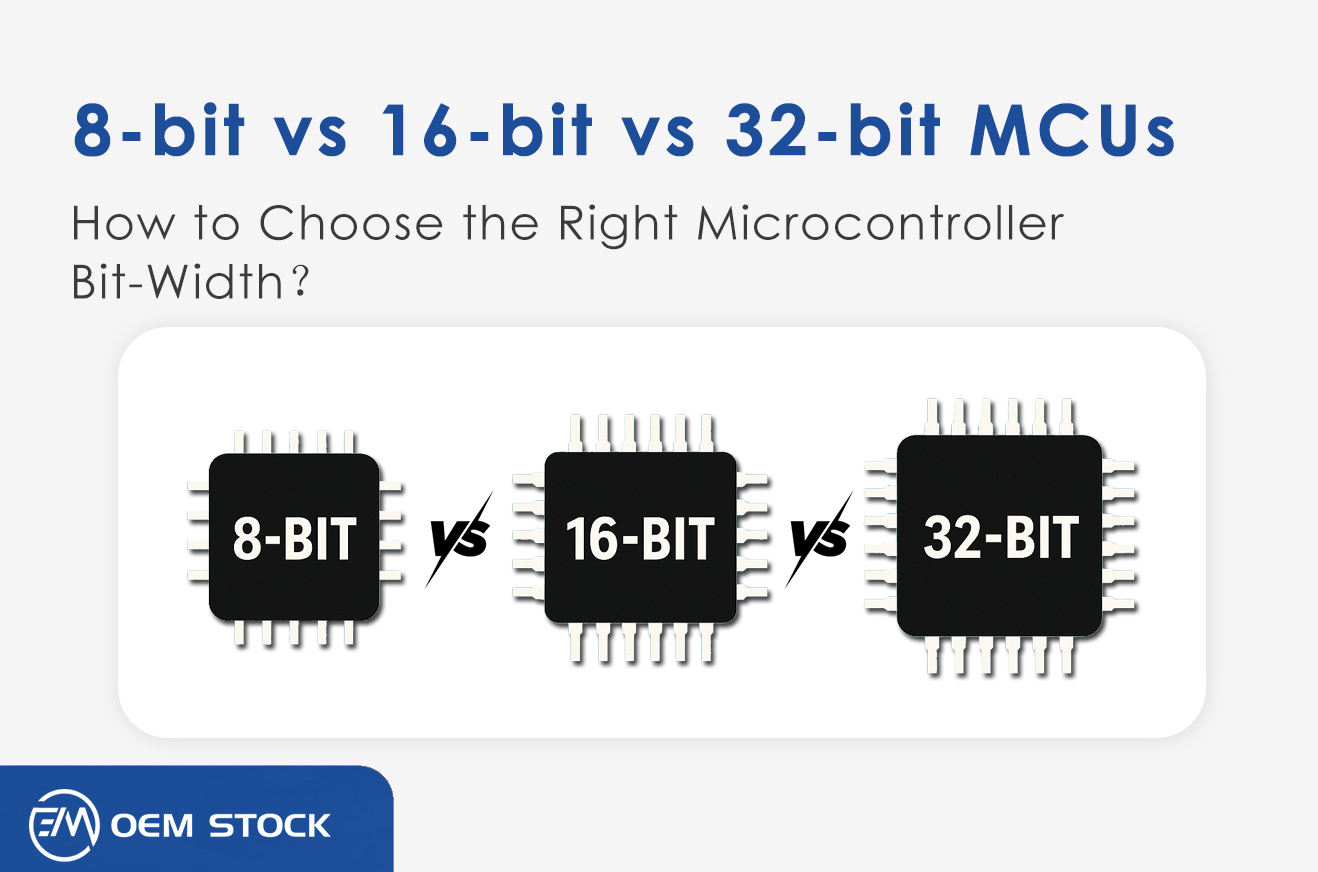
Bit-width (8/16/32-bit) is not a simple "performance ranking." This guide explains what bit-width really means,
how it affects timing, memory, tooling, and cost, and how engineers choose the simplest MCU that meets real
requirements.
Selection Logic Performance vs Cost Memory & Tooling Peripherals Low-Power Design
8-bit sweet spot
Simple control, ultra-low BOM
16-bit sweet spot
Balanced control + measurement
32-bit sweet spot
Complex stacks, rich peripherals
Engineering note
The most common mistake in MCU selection is treating bit-width as the primary decision factor. In many real
products, peripheral capability, memory architecture, interrupt behavior, and ecosystem maturity matter more
than whether the core is 8/16/32-bit.
Choose by workload
Control loops, buffers, and protocol stacks decide the class-not trends.
Validate worst-case
Peak MHz doesn't guarantee deadlines; latency and I/O contention do.
Tooling is a spec
Debuggers, libraries, and community support reduce engineering risk.
1) What "bit-width" actually means
"8-bit," "16-bit," and "32-bit" usually describe the native data width of the CPU core: register size, ALU
operations, and how efficiently the core handles arithmetic and addressing. But bit-width is not a single
performance number. Real-world throughput depends on clock rate, pipeline design, instruction set efficiency, and
memory access behavior (Flash wait states, bus contention, DMA usage).
In embedded control systems, the practical question is rarely "How fast is the core?" It is more often: Can the system reliably meet timing requirements while handling I/O, interrupts, and power constraints?
Rule of thumb
If your firmware spends most of its time waiting on I/O, timers, or peripherals, bit-width is rarely the
bottleneck. If your firmware does heavy math, buffering, or protocol processing, bit-width can become important.
2) 8-bit MCUs: simple, efficient, and often enough
8-bit MCUs remain popular because many embedded products are fundamentally simple: read inputs, apply logic,
control outputs, and occasionally communicate. 8-bit devices often provide excellent cost efficiency and can be
very power-friendly.
Where 8-bit MCUs shine
Simple control: appliance logic, button scanning, LED control
Cost-sensitive: high-volume consumer products
Ultra-low power: long idle time, infrequent wake-up tasks
Where 8-bit MCUs struggle
Larger protocol stacks, encryption-heavy workflows, high-rate sampling, and memory-hungry features can exceed
typical 8-bit Flash/RAM capacity.
Real selection signals for 8-bit
-
Your codebase is small and stable.
-
You need a modest number of GPIOs, timers, ADC channels, and perhaps a UART.
-
Power and BOM cost are top-level constraints.
-
Validation and manufacturing simplicity are more valuable than feature headroom.
3) 16-bit MCUs: the "balanced" class for control + measurement
16-bit MCUs often exist where engineers need better numeric capability than 8-bit without the ecosystem overhead
or cost that sometimes comes with 32-bit platforms. Many 16-bit families are optimized for control loops,
measurement, and power electronics tasks, often with strong timer/ADC integration.
|
Why teams choose 16-bit
|
Practical impact
|
|
Better numeric performance
|
More efficient handling of control math and signed arithmetic
|
|
Control-focused peripherals
|
Timers, ADC triggers, capture/compare features often well-integrated
|
|
Balanced cost and power
|
Often more headroom than 8-bit without moving to a heavy stack
|
Design caution
In some markets, 16-bit ecosystems can be narrower than 32-bit. Consider long-term availability, development
tools, and library support before committing.
4) 32-bit MCUs: ecosystem, peripherals, and scaling headroom
32-bit MCUs are widely adopted because they enable richer software and typically offer advanced peripheral sets:
DMA, high-resolution timers, multiple communication interfaces, hardware crypto, and modern debug features.
For many teams, the biggest advantage is not raw speed-it's the ecosystem: drivers, middleware, RTOS support,
and documentation maturity.
Where 32-bit is the default choice
-
IoT endpoints that require encryption, OTA updates, and complex connectivity
-
Industrial controllers running multiple protocols or fieldbuses
-
Motor control systems requiring advanced PWM and fast ADC sampling
-
Products that need long-term feature growth or reuse across platforms
Common 32-bit pitfalls (and how to avoid them)
-
Over-selecting "just in case" → increases cost/power and validation time
-
Ignoring power-state behavior → "low power MCU" that never sleeps properly
-
Driver overhead → heavy HAL usage that breaks timing determinism
5) The real trade-offs: performance, peripherals, power, and risk
In practice, bit-width correlates with platform capability, but it is not the root cause of success. Use this
selection approach:
Selection approach engineers actually use
Workload
-
How much math and buffering?
-
How many interrupts and deadlines?
-
How complex are comms stacks?
Peripherals
-
Timers/PWM requirements?
-
ADC sample rate and triggering?
-
Need DMA, CAN, USB, Ethernet?
Risk & lifecycle
-
Tooling and debug support?
-
Long-term supply and variants?
-
OTA update and security needs?
6) Common mistakes and how to avoid them
Mistake A: choosing the most powerful MCU "for safety"
This often increases BOM cost, power consumption, and validation workload without improving reliability. A better
approach is to choose the simplest MCU that meets requirements and keep headroom by optimizing peripheral usage,
memory layout, and ISR design.
Mistake B: choosing the cheapest MCU and hitting limits late
If you plan to add features (security, OTA, new protocols), leaving no memory or CPU headroom can force a redesign.
Early profiling and memory budgeting prevent this trap.
Mistake C: ignoring ecosystem and production constraints
Toolchain stability, debugger support, and driver maturity often outweigh core specs. Also consider packaging,
temperature grade, and supply continuity early-especially for industrial products.
FAQs
Is 32-bit always the best choice for new designs?
Not always. If your application is simple, cost-sensitive, and stable, 8-bit can be the best engineering choice.
The "best" MCU is the one that meets requirements with the lowest complexity and risk.
When does bit-width matter the most?
Bit-width matters when you have math-heavy workloads (filters/control algorithms), large buffers, complex protocol
stacks, encryption, or when you need modern peripherals and DMA capabilities that are more common in 32-bit
families.
How do I decide quickly if 8-bit is "enough"?
If you can budget Flash/RAM comfortably, meet timing deadlines with simple interrupts, and your peripheral needs
are modest, 8-bit is often enough. Validate by profiling worst-case ISR load and memory use early.
 Upload