Ever picked up a tiny resistor and wondered what those colourful stripes actually mean? You're not alone - every electronics hobbyist faces that moment. Those bands aren't decoration; they hold the key to understanding your resistor's value, tolerance, and precision. In this guide, we'll walk through how to decode resistor colour codes by sight, how 4-band and 5-band systems differ, and a few practical tricks so you can read them quickly without a chart.
Resistors haven't always been marked with colourful stripes - but the system dates back nearly a century. In the early days of radio manufacturing during the 1920s and 1930s, components were large, hand-assembled, and often lacked any markings at all. Technicians needed a quick way to identify part values directly on crowded circuit boards. Printed numbers weren't practical yet: the ink technology couldn't survive heat from soldering, and the bodies of early carbon-composition resistors were far too small for legible text.
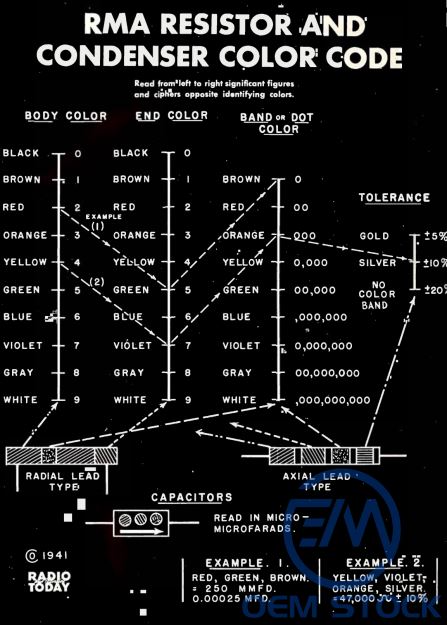
To solve this, the Radio Manufacturers Association (RMA) introduced the first colour-band code in the mid-1920s - a simple, paint-based visual system that could be read at a glance. Each colour corresponded to a digit from 0 to 9, allowing a two-digit number plus a multiplier to describe any resistor value. The idea worked so well that it became part of the EIA (Electronic Industries Alliance) and later IEC standards still used today.
Beyond convenience, the choice of colours was deliberate. The bands had to remain readable under dim light, resist heat, and avoid confusion even for colour-blind technicians - which is why colours like black, brown, red, and orange were chosen for the most common digits. Gold and silver were reserved for tolerance because they were metallic paints that stood out from the rest.
Even now, nearly a century later, the colour code survives because it's efficient and universally recognizable. Modern manufacturing could easily print numeric values, but the colour-band method is faster to apply, easy to read from any angle, and remains cost-effective for billions of through-hole resistors made every year.
Most resistors follow one of two colour systems:
The key difference: a 5-band resistor adds one more significant digit before the multiplier, allowing for finer accuracy.
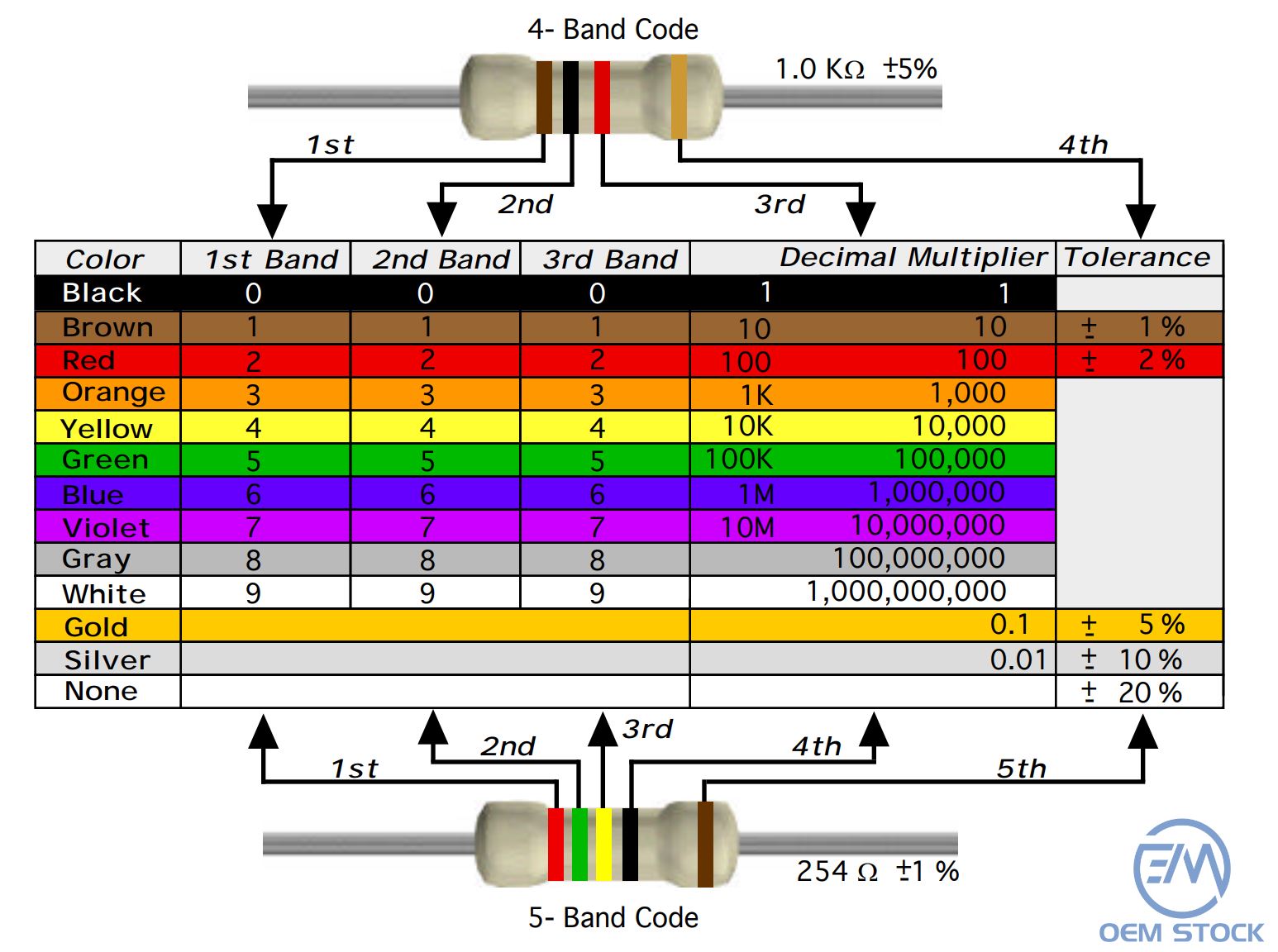
| System | Band 1 | Band 2 | Band 3 | Band 4 | Band 5 |
|---|---|---|---|---|---|
| 4-Band | 1st Digit | 2nd Digit | Multiplier | Tolerance | - |
| 5-Band | 1st Digit | 2nd Digit | 3rd Digit | Multiplier | Tolerance |
The following chart summarizes each colour's numeric value and its corresponding multiplier and tolerance.
| Colour | Digit | Multiplier | Tolerance |
|---|---|---|---|
| Black | 0 | ×1 | - |
| Brown | 1 | ×10 | ±1% |
| Red | 2 | ×100 | ±2% |
| Orange | 3 | ×1 000 | - |
| Yellow | 4 | ×10 000 | - |
| Green | 5 | ×100 000 | ±0.5% |
| Blue | 6 | ×1 000 000 | ±0.25% |
| Violet | 7 | ×10 000 000 | ±0.1% |
| Gray | 8 | ×100 000 000 | ±0.05% |
| White | 9 | ×1 000 000 000 | - |
| Gold | - | ×0.1 | ±5% |
| Silver | - | ×0.01 | ±10% |
| None | - | - | ±20% |
Example 1: 4-Band Resistor – Brown, Black, Red, Gold
Example 2: 5-Band Resistor – Brown, Black, Black, Red, Brown
Tolerance tells you how far the actual resistance may deviate from its nominal value. For example, a 1 kΩ resistor with ±5% tolerance could be anywhere between 950 Ω and 1 050 Ω. Precision resistors (±1% or ±0.1%) are used in measurement circuits, while ±5% is common in general electronics.
The colour bands correspond directly to these tolerances - brown for 1%, red for 2%, gold for 5%, silver for 10%, and no band for 20%.
Even professionals misread bands occasionally. Here are some typical issues that can lead to confusion:
Count the coloured rings. If there are four, it's a 4-band (two digits, one multiplier, one tolerance). If there are five, it's a precision resistor (three digits, one multiplier, one tolerance).
Yes. There are free "Resistor Color Code" apps that use your camera to identify colours automatically. They're convenient but can misread under poor lighting, so always double-check manually.
Measure the resistance with a multimeter instead. Discoloration can also mean the resistor overheated - replace it if readings are unstable.
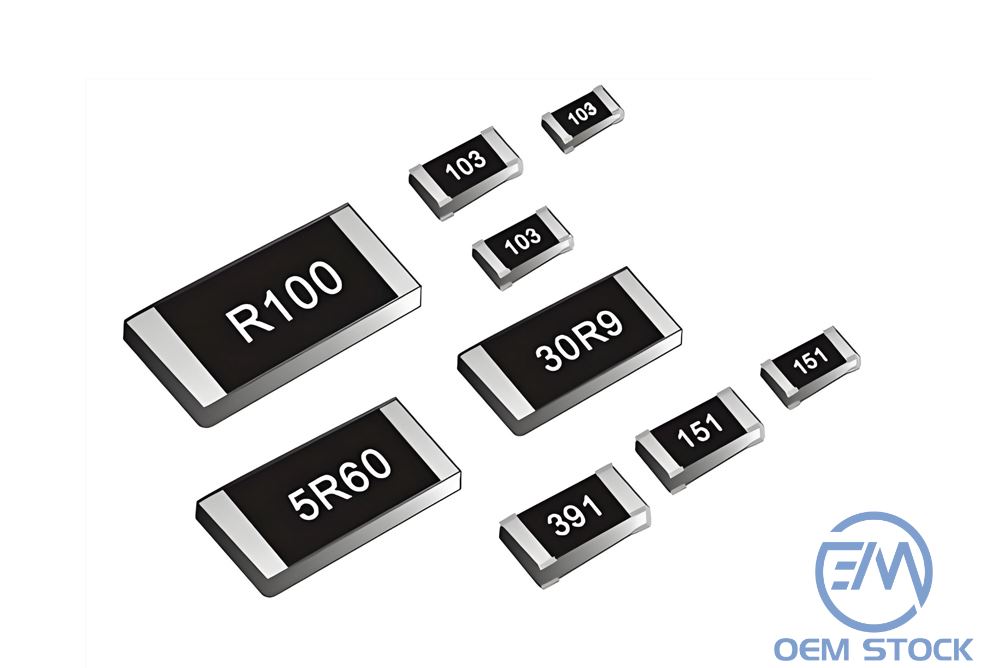
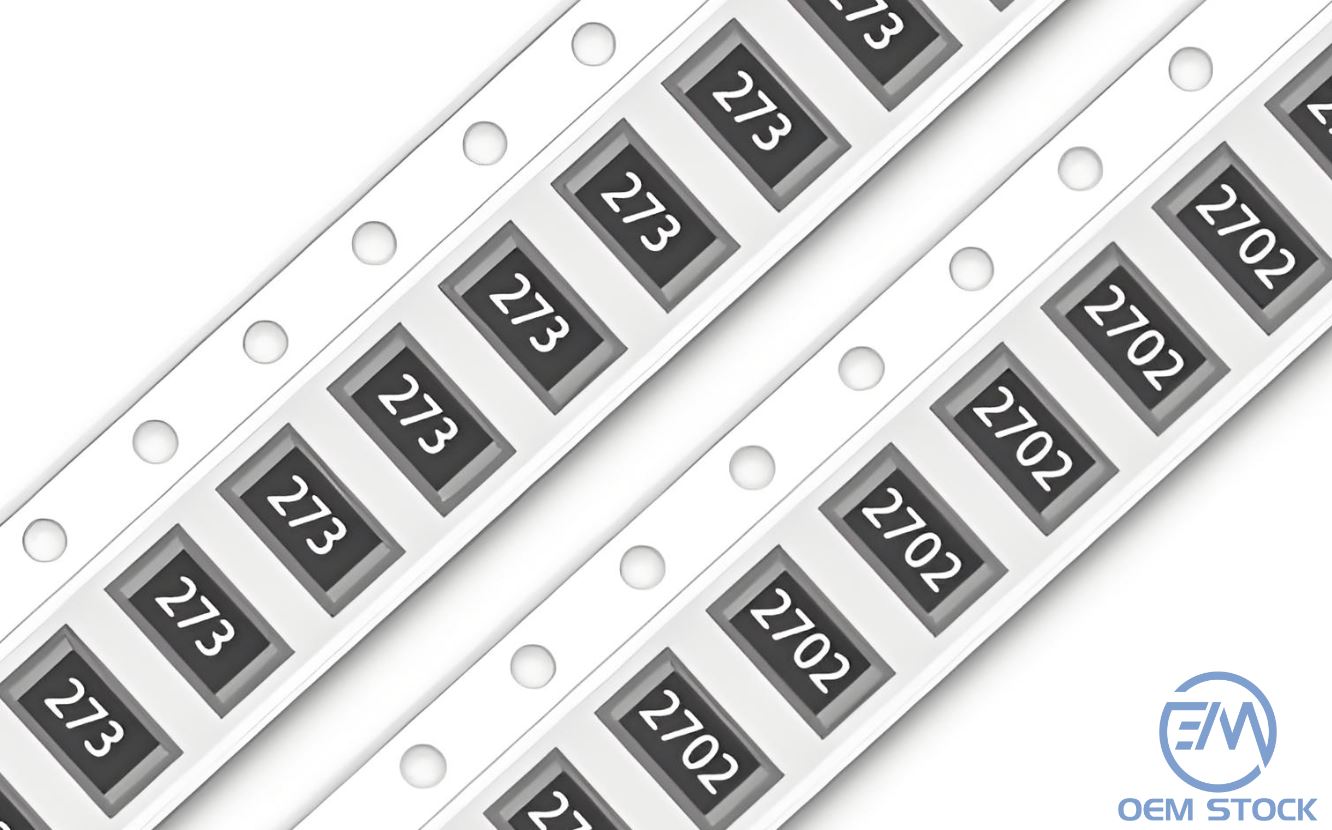
They're too small for bands. Instead, SMD parts use a numeric code (like "103" for 10 kΩ) printed on top - a topic we cover in SMD Resistor Selection Guide.
 Upload